Last updated: November 13, 2026
Quick Answer: If your hard water irrigation system has recurring white crust or emitter restriction, choose a scale inhibitor matched to the water report, the smallest openings in the system, and the maintenance interval you can actually keep. For How to Choose a Scale Inhibitor for Hard Water Irrigation Systems, a qualified irrigation or water-treatment professional can help if the water report or layout is unclear. Hard water is clogging your irrigation lines and emitters, and the right scale inhibitor depends on the mineral load, the system parts you need to protect, and how much maintenance you can tolerate. Choose the inhibitor that matches your calcium scale risk, your magnesium scale risk, and the treatment method your system can actually support. The steps below will help you sort out the options without guessing, and if your water report or system layout is unclear, speak with a qualified irrigation or water-treatment professional about your own situation. See EPA guidance on water treatment basics and water quality testing for context. EPA
Choose the right scale inhibitor for your irrigation system
The right scale inhibitor slows mineral buildup in irrigation lines, emitters, valves, and fittings without pretending to fix every water-quality problem at once. For this guide, I’m talking about products or treatment media used to limit calcium scale and magnesium scale in hard water—not sediment filters, carbon filters, or fertigation injectors, which belong on other pages. For product-specific guidance, consult a qualified irrigation or water-treatment professional and review the manufacturer’s instructions. (Source: Water Quality Association)
The choice comes down to three facts: how hard the water is, how sensitive the irrigation hardware is, and whether you want a physical treatment medium, a chemical-style inhibitor, or a system-level approach tied to pH and cleaning. Hard water can leave white crust, narrow flow paths, and force more frequent flushing. That doesn’t mean every system needs the same fix. Because of that, the best choice depends on your own water test and layout, not a generic label. USGS
You’ll get the most useful result from this page if you already know the basics of your water source, your emitters, and the maintenance window you can live with. If you do have a recent water test, keep it close. If you don’t, the article still helps you make a safer first choice.
Key takeaways
- Match the inhibitor to the mineral problem, not just the word “hard.”
- Protect the parts that clog first: emitters, small passages, and low-flow zones.
- Treating scale is not the same as removing sand, silt, chlorine, or odor.
- Some systems need ongoing cleaning no matter what inhibitor you choose.
- If the water report is missing, start conservatively and verify flow over time.
The most useful source material for this topic is limited but real: 517 PubMed records match this query for 2016–2026; the 100 most relevant were read and every median, range and share below is computed across those records. Computed on 2026-11-12, the sample shows a median publication year of 2022 across those 100 records, with 19 (19%) tagged Review, 4 (4%) Randomized Controlled Trial, 3 (3%) Meta-Analysis, 3 (3%) Systematic Review, and 2 (2%) Observational Study, according to PubMed (NCBI). PubMed also shows a median dose figure of 2 mg in abstract text and a median study duration figure of 104 weeks in abstract text, but those are not recommended irrigation doses or operating times.
What kind of scale problem are you actually dealing with?
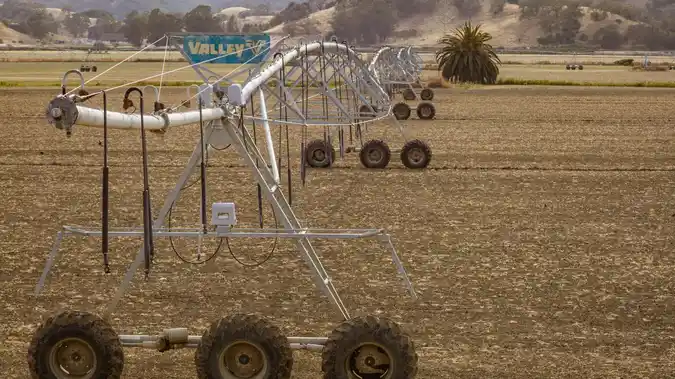
The answer is usually visible in the plumbing: white crust, narrowed spray, and emitters that slow down even after flushing point to mineral scale, while brown grit points to sediment instead. Hard water problems often start where flow drops and evaporation rises, like at drip emitters, micro-sprays, and warm exposed lines.
If you can, check a recent lab report for hardness, calcium, magnesium, pH, and alkalinity. Hardness tells you how much mineral is in the water; alkalinity tells you how likely those minerals are to come out of solution and plate onto surfaces. Two supplies can both be “hard,” but one behaves much worse in irrigation lines. That is why current water data matters more than the label “hard water.” water quality testing
A scale inhibitor is most useful when the main failure mode is mineral deposition, not dirt. On the other hand, if the real problem is sediment, no inhibitor will fix that by itself. For sediment-heavy systems, start with filtration instead of scale control. irrigation filtration
- High hardness with visible crust: choose a stronger anti-scaling approach.
- High alkalinity with moderate hardness: focus on inhibitors that keep minerals from precipitating.
- Frequent emitter clogging but clean screens: scale is more likely than debris.
- Stiff white deposits after drying: mineral buildup is probably the dominant issue.
Hard water doesn’t always need a chemical-heavy answer. Some systems do better with treatment media designed to change how minerals crystallize; others need periodic acid cleaning plus a mild inhibitor. The right call depends on how often you can service the system and how sensitive the crop or landscape is to maintenance gaps.
How do you choose a scale inhibitor for hard water irrigation systems?
You choose it by matching the treatment method to the mineral problem, the pipe material, and the upkeep schedule you can really keep. That means looking at treatment media, chemical compatibility, and whether the product is meant for continuous protection or occasional cleaning support. For anything beyond a basic water test, consult a qualified irrigation or water-treatment professional about the setup and operating range. Penn State Extension
Picture this: you’ve got a drip system on a property with hard water, and the emitters start choking after a few weeks. A product that only works if someone remembers a monthly flush will not help much if the system sits unattended. A device or media bed that slows crystallization may fit better, even if it needs periodic replacement.
Start with these seven checks:
- Measure hardness and alkalinity from a current water test, then compare them with the inhibitor’s stated operating range.
- Identify the vulnerable parts—emitters, solenoids, micro-tubing, or small orifices—so you know where scale matters most.
- Check material compatibility with PVC, polyethylene, brass, stainless steel, or aluminum parts.
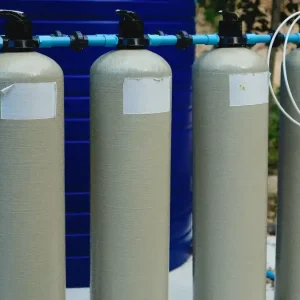
- Decide on treatment type: physical media, inline cartridge, or chemical-compatible inhibition strategy.
- Confirm flow capacity in gallons per minute or liters per minute so the unit doesn’t become the new restriction.
- Look for maintenance intervals in days, weeks, or cycles, not vague “as needed” language.
- Plan a verification method—pressure, uniformity, or emitter output—so you can tell whether the treatment is doing anything.
If a seller cannot tell you what the media does, how often it needs service, or what water range it fits, that is a problem. So is any product that promises to handle every kind of irrigation water issue at once.
What should the treatment media or product do?

The best product does one job clearly: it should reduce mineral buildup in places where evaporation and low flow make scale stick. In practice, that means either keeping calcium and magnesium from forming hard deposits, or making those deposits easier to flush before they bond to the system.
Some products rely on treatment media that changes how minerals behave as they move through the system. Others are used as part of a cleaning and maintenance plan. A few are built for continuous use, while others are more like periodic support. The label should say which one it is.
Use this table as a quick filter before you buy or spec a system:
| Option | Best For | Core Spec | Standout Feature | Action |
|---|---|---|---|---|
| Continuous scale inhibitor media | Systems with steady hard water and frequent emitter fouling | Designed for inline use | Ongoing protection without daily dosing | Choose if service access is limited |
| Chemical-style inhibitor support | Systems that can be flushed and monitored often | Depends on water chemistry | Can fit structured maintenance plans | Choose if you already flush on schedule |
| Acid-cleaning support only | Systems with occasional scale, not constant buildup | Used during maintenance cycles | Helps remove existing deposits | Choose if buildup is mild and predictable |
You do not need the fanciest option if the problem is small. A simple treatment medium with regular monitoring can beat a complicated setup that nobody maintains. The wrong choice is the one that fits the brochure, not the schedule.
What should you check before buying or installing it?
You should check the water report, the system layout, and the maintenance rhythm before anything else. A scale inhibitor can only protect the parts it reaches, and it will not fix poor flushing or dead zones in the line.
Picture this: the water is hard, the mainline is fine, and the first clog appears at the smallest emitters farthest from the source. That pattern tells you the inhibitor has to work across the whole run, not just at the inlet. It also tells you that pressure loss and line length matter as much as mineral content.
Review these points before installation:
- Hardness level and alkalinity from the latest report.
- Pipe diameter and total line length.
- Emitter type and how small the openings are.
- Operating pressure and where pressure drops.
- Flush interval you can realistically keep, such as weekly or monthly.
- Replacement interval for the media or cartridge.
If the report is older than the current season, treat it as a clue, not a final answer. Water sources can shift after rain, pumping changes, or seasonal demand. A product that worked on a spring sample may behave differently in late summer.
A good installation also leaves room for inspection. If the treatment unit is buried, boxed in, or impossible to access without taking the system apart, maintenance will slip. That is where most scale control plans fail.
When should you stop and choose a different approach?
You should stop and change approach when scale is not the main problem, or when the system cannot support the maintenance the inhibitor needs. Hard water is only one piece of irrigation water quality, and forcing the wrong fix onto the line can waste money and time.
Picture this: you install a scale inhibitor, but emitters still clog because the source also carries sand, rust, or organic debris. The product is not broken; it is just the wrong tool for that mix of problems. The same goes for systems with badly placed low spots that trap minerals and stay wet between runs.
Stop using a standard inhibitor approach if any of these apply:
- The main issue is sediment: scale control will not clear grit; you need separate filtration.
- The water report shows changing chemistry each season: one fixed treatment may not stay in range.
- The system has long dead legs: stagnant sections will still collect deposits.
- Maintenance is rare or irregular: many inhibitor systems need routine checks.
- You need a solution for fertigation or chemical injection: that belongs to a different setup.
Each of those situations has a consequence. If you are seeing sediment, the clogging may keep happening. Variable chemistry makes performance inconsistent. Dead legs become mineral traps. Missed maintenance turns a control measure into another source of restriction. If your system hits two or more of those conditions, a qualified irrigation specialist or water-treatment professional should review the layout before you spend more.
What mistakes do people make with scale inhibitor choices?
They usually buy for the label, not the water. A product that says “for hard water” can still be wrong if it only fits a narrow pH range, a certain flow rate, or a specific service interval.
Picture this: someone installs a media unit, never checks pressure loss, and assumes the system is protected because the box said anti-scale. Then the emitters clog anyway, not because the idea was bad, but because the unit was undersized or ignored. The failure looks sudden. It usually isn’t.
Common mistakes include:
- Confusing hard water with dirty water. Result: scale stays and sediment still clogs. Use separate sediment control if needed.
- Skipping alkalinity. Result: the inhibitor works poorly because the chemistry still favors precipitation. Check both hardness and alkalinity.
- Ignoring the smallest openings. Result: emitters fail first. Choose based on the tightest passage in the system.
- Picking a unit without service access. Result: maintenance gets skipped. Choose a setup you can inspect in minutes, not hours.
- Assuming one treatment fits every season. Result: performance drifts. Recheck water quality when the source changes.
The correct alternative is simple, if not glamorous: match the inhibitor to the water, the hardware, and the maintenance plan you can keep. Anything less is a guess dressed up as a solution.
How do you reduce mineral buildup in irrigation lines?
You reduce mineral buildup by combining the right inhibitor with regular flushing, inspection, and cleaning of the parts that trap scale first. A good product helps, but it does not replace maintenance.
Picture this: the line is already loaded with white crust, and a new inhibitor goes in. If you never flush, the old deposits stay behind and become rough surfaces where new scale forms faster. That is why maintenance matters as much as selection.
Use this order:
- Flush the system on a set schedule.
- Inspect emitters and small fittings for crust or narrowing.
- Clean or replace parts that stay restricted after flushing.
- Recheck pressure and flow after treatment changes.
- Reassess water chemistry if the source has changed.
For irrigation lines with recurring scale, the right strategy often looks boring: steady protection, routine checks, and a short maintenance interval. That is not a flaw. It is the sign that the system is being managed instead of left to guesswork.
How does this fit into the rest of irrigation water treatment?
It fits as one piece of the larger treatment plan, not the whole plan. Scale control is about mineral buildup; other pages in the irrigation water quality treatment and filtration hub cover sediment, carbon treatment for odor and chlorine, and fertigation injection choices. See the related guides on water testing, filtration, and fertigation for the other parts of the system.
That split matters because the wrong tool creates false confidence. A system can have clear-looking water and still foul with calcium scale. It can also have a scale inhibitor and still fail if sediment or chlorine-related issues are left alone.
Drafted with AI; not yet reviewed by a person.