Last updated: November 13, 2026
Quick answer: Irrigation water quality treatment and filtration usually starts with identifying the clogging cause, then matching pretreatment and filtration to the source. In many systems, one screen filter is not enough. This guide explains how to choose the right setup for sand, silt, algae, iron, hardness, and biofilm.
Irrigation water that carries sand, silt, algae, iron, or hardness can clog emitters, stain crops, and knock a whole system off balance. The right treatment depends on the water source, the clogging problem, and the filtration method already on the line, and a qualified professional can help confirm the best match for your site. The sections below settle what to check first, what to install, and when a simple screen is not enough.
What this guide applies to, and what it assumes you already know
This guide applies to growers, grounds crews, and property managers who need irrigation water to pass through pipes, valves, emitters, sprinklers, or drip tape without frequent clogging. It assumes you already know your water source is one of the common ones—well, pond, canal, reuse, or municipal—and that the problem is not just “dirty water,” but a specific failure such as plugged emitters, abrasive wear, slime, or scale.
If you do not yet know the water source, the flow rate, or the type of irrigation hardware on the line, stop there first. A filtration plan for drip tape on a 100-mesh screen is not the same as a plan for big-zone sprinklers or a pivot with higher flow demand. For health-related concerns in reused or contaminated water, speak with a qualified professional about your own situation before making changes; water quality issues can overlap with local rules and crop safety.
The best starting point is to identify the particle, mineral, or biological load that is causing trouble. A sand-heavy well, an algae-filled pond, and iron-rich groundwater all fail in different ways, and they need different answers. One-size-fits-all treatment can mean extra maintenance and poor results, so a qualified professional is often worth consulting before you commit.
Key takeaways
- Match the treatment to the problem, not to the filter catalog, and confirm the choice with a qualified professional when the source is uncertain.
- Drip systems need finer protection than many sprinkler systems.
- Pretreatment can matter as much as filtration when the water carries iron, algae, or organic slime, but a qualified professional should verify the sequence.
- Backwash performance is part of the design, not an afterthought.
- Bad source water can overwhelm a good filter if the system is undersized or checked too rarely.
How irrigation water quality is judged in practice
Irrigation water quality is judged by what it does to the system, not by a single lab number. A sample can look clear and still cause emitter clogging, scale, or biological growth. The main troublemakers are suspended solids, dissolved minerals, iron and manganese, and organic material such as algae or biofilm.
Picture this: you have a field or nursery block with emitters that start clean and then slow down after a few weeks. You need to know whether the issue is particle size, mineral precipitation, or biological growth before you choose a filter train. The difference decides whether a screen filter, a media filter, or a chemical pretreatment step is doing the heavy lifting.
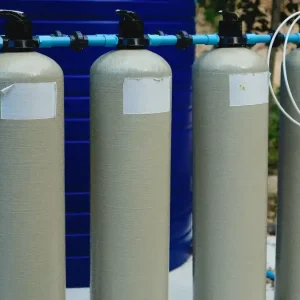
Common terms matter here. A screen filter uses a mesh or perforated element to trap larger particles. A media filter pushes water through a bed of sand or similar media and catches finer and softer debris. Backwash means reversing flow to flush trapped material out of the filter body. That last part is not optional on many systems; if backwash is weak, the filter clogs itself.
A practical check list usually starts with these questions:
- Does the water carry visible sand after pumping starts?
- Does the water go cloudy after agitation or after a rain event?
- Are emitters clogging at random, or in patterns tied to pressure changes?
- Is there orange staining, black slime, or white scale?
- Is the water source stable all season, or does it change with weather and drawdown?
The source matters too. Groundwater often brings dissolved iron, manganese, or fine sand. Surface water more often brings algae, silt, leaves, and other organic load. Reuse water can combine suspended solids with biological growth and treatment by-products. Those cases often need more than a basic strainer on the inlet.
Two authoritative references that frame the subject are the American Society of Agricultural and Biological Engineers standard ASABE EP405.1, which deals with irrigation water quality and clogging risk, and the FAO irrigation water guidance used widely in agriculture. They are not the same thing, but both show the same principle: the water must be matched to the equipment and crop.
Which treatment method fits which water problem?
The right treatment method is the one that removes the material actually causing trouble, not the one with the biggest housing. Sand calls for a different answer than algae, and dissolved iron is a different problem again. That sounds obvious, but this is where many systems fail.
Picture this: you are deciding whether a filter alone is enough, or whether you need aeration, settling, chemical oxidation, or a second stage. The truth is, no single filter handles every load well. A 17-inch or 20-inch housing size, a 120-mesh element, or a bank of media vessels may sound impressive, but the number only helps if it fits the particle load and flow.
The main treatment families are:
- Settling or sediment removal: useful when water carries visible grit or heavy solids.
- Screen or disc filtration: useful when the main issue is coarse to medium particles.
- Media filtration: useful when the load is finer, softer, or more variable.
- Oxidation and separation: useful for iron, manganese, and some sulfur-related problems.
- Disinfection or biological control: useful where slime, algae, or biofilm keep returning.
- Water conditioning or softening in special cases: useful where hardness and scale are the real problem, though not every irrigation setup should use it.
The best part? The right treatment often starts upstream of the filter. If a pond draws algae all summer, a filter can catch the biomass only after the biomass has already reached the line. If a well brings dissolved iron, you may need oxygen contact time before filtration so the iron can change form and be caught as a solid. If a reuse source contains organic debris, a filter only works well when the upstream load is kept within its design range.
A basic rule works well in the field: particles get filtered; dissolved problems get transformed first. That means visible sand, silt, and leaf debris can often be managed with screens, discs, or media units. But iron that stays dissolved, or hardness that precipitates as scale, usually needs a different sequence before the filter can help.
Common irrigation water quality problems and the usual response
| Problem in the water | What it often does | Typical treatment direction | What to watch |
|---|---|---|---|
| Sand and grit | Abrasion, emitter wear, plugging | Settling plus screen or media filtration | Rapid pressure drop |
| Silt and fine clay | Slow clogging, muddy flush water | Media filtration or finer disc/screen stage | Frequent backwash need |
| Algae and organics | Slime, biofilm, odor, plugging | Straining, media filtration, and biological control | Seasonal spikes |
| Iron and manganese | Orange or dark staining, deposits | Oxidation then filtration | Precipitate formation |
| Hardness/scale | White crust in lines and emitters | Water conditioning in special cases | Precipitation at pressure changes |
Do not treat every muddy-looking source the same way. A canal after rain and a pumped well with iron are not cousins; they are different jobs.
What does the core treatment and filtration setup look like?
A complete irrigation water treatment setup usually starts with a coarse removal step, adds a main filtration stage, and then includes a way to clean or flush the system. In tougher water, a pretreatment step sits in front of filtration. The layout is more important than any one part.
Picture this: you are laying out the line from the source to the field, and every piece has to protect the next one. You want the pump to see clean enough water, the filter to see a manageable load, and the emitters to see water that no longer carries the worst debris. That sequence is the whole game.
The most common components are:
-
Intake screen or foot valve screen
This is the first line of defense. It blocks sticks, leaves, and larger debris before the pump or suction line. Verify that the open area is large enough for the pump demand. If the screen loads up quickly, the source is too dirty for this stage alone. -
Hydrocyclone or sand separator, where sand is the issue
This device spins water so heavier sand falls out. It works best with granular material, not algae or slime. Verify that there is enough pressure and velocity for separation. If sand still appears downstream, the separator is undersized or the particle mix is too fine. -
Main filter stage: screen, disc, or media
A screen or disc filter is common for many drip and micro systems. Media filters are better when solids are finer or more variable. Verify the mesh or media choice against emitter opening size and clogging history. If pressure loss rises fast, the load is too high or the filter is too small. -
Flush or backwash mechanism
This is what keeps the filter from becoming the problem. Verify that flushing moves enough water to carry debris out of the vessel or manifold. If cleaning does not restore performance, debris may be caking, not just trapping. -
Chemical or biological control step, where needed
Chlorination, acidification, or other controls may be used in some systems to manage slime, iron, or scale. These are not generic fixes. Verify that the material compatibility, crop sensitivity, and local rules allow the approach. If deposits keep returning, the root cause is still active. -
Pressure regulation and monitoring points
Pressure gauges or differential pressure indicators help show when the filter is loading. Verify that upstream and downstream readings are installed where they can be read easily. If the pressure drop keeps rising between checks, you need a bigger element or a cleaner source. -
End-of-line flushing
This clears settled debris from laterals and distribution lines. Verify that flush water is actually carrying out the debris, not just moving it around. If flushing brings little or no debris after a known clogging event, the blockage may be elsewhere in the system.
A complete setup is not always expensive or complicated, but it is never random. The order of the pieces matters as much as the pieces themselves.
How do I choose the right mesh, media, or separator?
You choose the filter by emitter sensitivity, particle load, and maintenance tolerance. A fine drip system often needs finer protection than a sprinkler block, but too-fine filtration can create constant pressure loss and frequent cleaning. That trade-off is the heart of the decision.
Picture this: you are standing between two bad options. A coarse filter passes too much debris, while a very fine filter chokes the line and needs constant care. The answer sits in the middle, with the water source and hardware dictating the range.
A practical selection process looks like this:
-
Identify the irrigation hardware first.
Drip tape, pressure-compensating emitters, micro-sprinklers, and large sprinklers do not share the same clogging risk. Verify the smallest opening or most sensitive component in the system. If you skip this step, you may under-filter or over-filter. -
Classify the source water.
Well, surface, and reuse water usually behave differently. Verify whether the dominant issue is sand, silt, algae, iron, or scale. If you cannot name the dominant issue, the filter choice is guesswork. -
Match the filter type to the solids.
Coarse grit often points to a separator or screen. Fine, soft, or variable solids often point to media filtration. Verify whether the debris is hard and abrasive or soft and sticky. If the wrong filter is chosen, cleaning frequency rises fast. -
Check the flow range, not just the average flow.
Peak demand matters because filters fail first under load spikes. Verify the highest expected operating flow. If the filter is sized only to a low-demand condition, pressure drop will jump when the system opens fully. -
Plan for cleaning.
Automatic backwash, manual flushing, or cartridge replacement all require time and water. Verify that the site can support the cleaning step without starving the rest of the system. If maintenance is too hard to carry out, the best filter on paper will still fail in practice. -
Think about fouling pattern.
If clogging appears in bursts after rain, storm runoff, or pumping changes, the source is variable. Verify whether the problem is seasonal or constant. If variable, a filter train with more than one stage often works better than a single stage. -
Use pressure drop as the real test.
The system should run with a manageable difference between inlet and outlet pressure. Verify that the differential pressure does not climb faster than the maintenance schedule can handle. If it does, the element is doing too much work.
The common mistake is to choose a mesh number or vessel size before the water problem is clear. That is backwards. The water tells you the hardware, not the other way around.
What should be checked before the system is turned loose?
The system should be checked for source quality, pressure behavior, cleaning performance, and downstream residue before it is left on its own. A new filter train can still fail if the upstream water changes or the maintenance plan is unrealistic.
Picture this: everything is installed, the pump starts, and the water looks better. That is not enough. You still need to know whether the filter can keep working after the first dirty pulse, the first backwash cycle, and the first hot week of the season.
A sensible pre-launch checklist includes these points:
- Source inspection: Is the intake in a stable zone, or near mud, algae mats, or sediment?
- Pressure check: Does the upstream and downstream pressure stay within the equipment range?
- Clean-water flush: Can the line be flushed until water clears without overloading the filter?
- Backwash test: Does cleaning restore the filter instead of merely stirring debris?
- Emitter check: Are the smallest outlets passing water evenly after startup?
- Residue check: Is there sand, orange stain, or slime appearing in strainers or flush outlets?
- Maintenance access: Can someone reach the filter, the valves, and the gauges without special tools?
The first 24 to 72 hours often reveal the truth. If the differential pressure rises quickly, the source load is higher than expected. If the water looks clear but emitters still plug, the problem may be dissolved iron, scale, or biological film rather than visible debris. If the cleanout water is heavy with sediment every time, upstream pretreatment is probably missing.
A note on water sampling: a single grab sample may not capture the full problem if the source changes by time of day, rain, or pumping depth. That is one reason field observation matters so much. The most useful check is often repeated observation under operating conditions, not a one-time lab snapshot.
When should a standard filter approach stop and a different one begin?
A standard filter approach should stop when the water contains dissolved contaminants, heavy biological growth, or enough solids that cleaning cannot keep up. At that point, more filtration alone is not the answer. The system needs pretreatment, source changes, or a different operating plan.
Picture this: you keep opening the same clogged filter, and each time it comes back dirty at the same pace. That is not a maintenance failure; it is a design mismatch. The job has outgrown the filter.
Here are specific situations that call for a different approach:
Visible sand keeps reappearing after backwash: The source is still carrying abrasive grit — Add sand separation or improve intake placement before the main filter.
Orange or brown deposits return after cleaning: Iron is likely oxidizing and dropping out downstream — Add oxidation and a filter stage designed to catch the precipitate.
Slime or biofilm comes back within days: Biological growth is active in the source or pipes — Use a biological control strategy that fits the crop and system materials.
The pressure drop climbs too fast between cleanings: The filter is undersized for the load — Move to a larger unit, a different media bed, or a staged setup.
Flushing does not restore flow: The blockage may be hardened scale or internal damage — Inspect the laterals, valves, and emitters instead of repeating the same cleaning cycle.
The source changes after rain or runoff events: The water is too variable for a single-stage solution — Use a staged approach that can handle spikes.
Maintenance access is poor: The best equipment will still fail if it cannot be cleaned on time — Simplify the layout or choose a lower-maintenance method.
The wrong move is to keep adding finer and finer filtration without checking the source. That can make pressure loss worse while leaving dissolved or biological problems untouched.
What are the most common mistakes, and what do they cost?
The most common mistakes are choosing the wrong filter type, ignoring pressure drop, skipping pretreatment, underestimating biological growth, and failing to maintain the system on schedule. Each one costs water, time, and uniformity.
Picture this: the field looks uneven, some lines run weak, and the operator keeps cleaning strainers that should not have been doing all the work in the first place. That is what a bad match between water and hardware looks like.
-
Buying a fine filter before identifying the source problem
Cost: repeated clogging or unnecessary pressure loss.
Better move: classify the water first, then choose the filter stage. -
Using a screen where a media filter is needed
Cost: fine solids pass through and clog emitters later.
Better move: use a media stage when the solids are soft, fine, or variable. -
Skipping pretreatment for iron or algae
Cost: the filter catches the result, not the cause.
Better move: oxidize, settle, or control growth upstream when that is the actual problem. -
Ignoring differential pressure gauges
Cost: the filter clogs silently until the system performance drops.
Better move: check upstream and downstream pressure routinely. -
Assuming one clean water sample tells the whole story
Cost: the filter is sized for the wrong condition.
Better move: observe the source under normal and peak conditions. -
Not planning for flushing waste
Cost: dirty water goes nowhere and accumulates in the system.
Better move: design a discharge path for backwash and line flush water.
The best systems are boring in the best way. They run, they flush, they recover, and they do not need heroic maintenance every week. If the setup only works when someone babysits it, it is not yet a finished design.
How long does treatment take, and what does a good result look like?
Treatment is ongoing, but the visible result should be quick: clearer flush water, steadier pressure, fewer plugged outlets, and less residue in the filter body. A good result is not “perfect water”; it is water that stays within the system’s tolerance with reasonable maintenance.
Picture this: after installation, you want to know whether the system is actually improving or just shifting the problem from one part to another. That answer usually shows up in the first days and weeks, not months.
A good result usually looks like this:
- The filter loads at a predictable rate, not in sudden bursts.
- The backwash or cleaning cycle restores flow.
- End-of-line flush water becomes cleaner over time.
- Emitters run more evenly across the block.
- Orange stain, slime, or grit becomes less frequent in inspection points.
- Maintenance moves from emergency cleaning to routine service.
A poor result looks like this:
- Pressure drop rises too fast.
- Filter cleaning is needed far more often than planned.
- Deposits return after every flush.
- Some zones run well while others starve.
- The same clogging pattern repeats after rain, pumping changes, or temperature swings.
Timing depends on the source. A sand-heavy well may show improvement immediately after a separator and proper filter stage are added. A biofouled system may need repeated control cycles before the line stabilizes. A scale issue can take longer because the deposits may already be built inside pipes and emitters.
Do not judge success only by the water at the source. The real measure is what reaches the last emitter or sprinkler head after the water has passed through every valve, bend, and filter stage.
What kind of professional help is worth getting?
The right help is source-specific water quality expertise or irrigation design support, not a generic parts sale. A good specialist can connect the water analysis, the clogging pattern, and the hardware layout in one plan. That matters when the source is variable, when reuse water is involved, or when the system has already failed once.
Picture this: the water problem has outgrown the simple fixes. You need someone who can tell the difference between sediment, dissolved iron, scale, and biological growth, and who can design around the real bottleneck. That is not a filter catalog decision.
A qualified review is especially useful when:
- the source is changing through the season,
- the system feeds sensitive emitters,
- crop or turf uniformity matters,
- the line already has deposits,
- or the water comes from a source with treatment rules attached.
The hard truth is that some systems are not a filtration problem alone. They are a source, design, and maintenance problem all at once. Treating only one layer often buys a short reprieve and nothing more.
FAQ
Do I always need a filter on irrigation water?
No, but most systems need some form of protection if the source carries sand, silt, algae, or scale-forming minerals. The right level depends on the source and the smallest opening in the irrigation hardware. A clean municipal source may need less protection than a pond or a sandy well.
Is screen filtration enough for drip irrigation?
Sometimes, but not always. Screen filtration works well for larger particles, yet fine silt, algae, and sticky debris often need media filtration or an added pretreatment step. If emitters clog even after cleaning the screen, the water load is probably finer than the screen can handle.
What is the difference between a screen filter and a media filter?
A screen filter traps debris on a mesh or perforated surface, while a media filter traps particles inside a bed of granular material. Screen units are simpler and common for lighter loads; media units are better when the water carries finer or more variable solids. The best choice depends on what the water actually contains.
Can iron in water be removed with filtration alone?
Not usually, if the iron is dissolved. Filtration works after the iron has been changed into a solid form, which is why oxidation or another pretreatment step may be needed first. If the water keeps leaving orange deposits, the filter may be catching only part of the problem.
How often should irrigation filters be cleaned?
That depends on the source load, the filter type, and the flow rate. The better rule is to clean when pressure drop rises to the point the system needs it, not on a fixed guess. If cleaning is needed very often, the system is likely undersized or the source needs pretreatment.
Drafted with AI; not yet reviewed by a person.