Last updated: November 21, 2026
Quick Answer: for the topic “Sprinkler System Installation Cost by Lawn Size, Zone Count, and Layout: related questions,” a simple yard can stay near the lower end, while a divided yard with 5+ zones usually costs more. Sprinkler system installation cost rises with lawn size, zone count, and layout complexity, not just with the number of heads. A small, simple yard can stay near the lower end because it needs fewer trenches, fewer valves, and less pipe. A bigger yard with split front-and-back areas, narrow strips, or mixed sun and shade usually costs more because it needs more zones and more labor. For related planning, EPA WaterSense and the Irrigation Association both stress matching the system to the site, not the other way around.
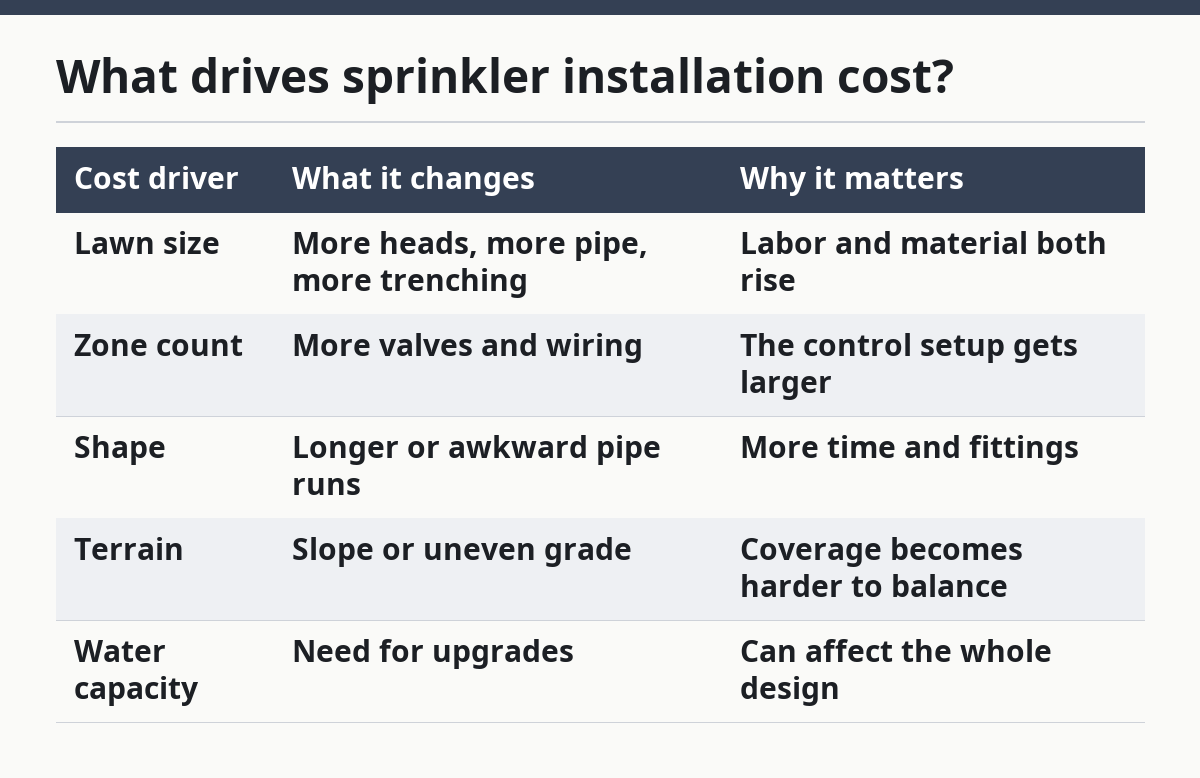
What drives sprinkler installation cost?
Sprinkler installation cost is driven by pipe length, zone count, and how hard it is to route water around the yard. A clean rectangle is cheaper than a yard with curves, islands, side yards, and tight gates, because the installer spends less time on trenching and fitting parts. That is also why layout is a pricing factor, not just a design detail. EPA WaterSense and the Irrigation Association both emphasize efficient design and proper zoning.
The biggest cost drivers are easy to spot once you picture the layout:
- Lawn size — more square footage usually means more heads, more pipe, and more labor.
- Zone count — each zone needs valves and wiring, so more zones raise the price.
- Layout complexity — slopes, narrow strips, tree beds, fences, and long runs add labor.
- Water supply needs — if the existing supply cannot handle the system, upgrades may be needed.
- Local conditions — frost depth, clay soil, rocky ground, and local rules change the job.
A simple yard can be straightforward enough to plan in one visit. A yard with separate front, back, and side sections often needs a more careful design because the coverage has to match pressure and flow. The wrong setup wastes water and leaves dry spots, while the right setup gives even coverage without oversizing the system.
| Cost driver | What it changes | Why it matters |
|---|---|---|
| Lawn size | More heads, more pipe, more trenching | Labor and material both rise |
| Zone count | More valves and wiring | The control setup gets larger |
| Shape | Longer or awkward pipe runs | More time and fittings |
| Terrain | Slope or uneven grade | Coverage becomes harder to balance |
| Water capacity | Need for upgrades | Can affect the whole design |
For cost planning, the question is not “How big is the lawn?” alone. It is “How many separate watering decisions does the yard force?” That is where the bill grows.
How does lawn size change the price?
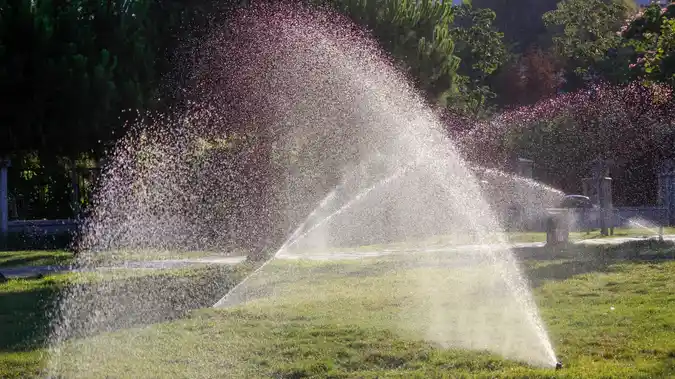
Lawn size changes the price because bigger areas need more coverage points and more pipe runs. A small yard with one open rectangle may need fewer zones than a larger yard broken into front, back, and side sections. That difference shows up quickly in both materials and labor.
A useful way to think about it is by lawn shape, not just acreage:
| Lawn layout | Typical cost pressure | Why |
|---|---|---|
| Small, open rectangle | Lower | Short runs and fewer turns |
| Medium yard with one divide | Medium | One extra zone may be needed |
| Large yard with several sections | Higher | More heads, valves, and labor |
| Narrow or irregular yard | Higher | Coverage overlaps are harder to set |
| Sloped yard | Higher | Pressure and runoff need more care |
The same square footage can cost differently depending on the shape. A 2,000-square-foot yard that is a simple box is easier than a 2,000-square-foot yard split by a patio, driveway, and planting beds. The first may need a simpler layout; the second may need extra zones to avoid overwatering one section and underfeeding another.
The detail that matters most is the coverage pattern. A good layout keeps spray heads matched to the distance and shape of the grass. A bad layout uses too few heads, leaving dry arcs, or too many, which can cause overspray onto sidewalks and walls. That is why size alone is not enough to price the job.
Why does zone count matter so much?
Zone count matters because each zone is a separate watering circuit, and each circuit adds valves, wiring, and design time. More zones let the system water different parts of the yard for different lengths of time, which is useful when sun exposure, slope, and plant type change from one area to another.
A simple rule is that zones are not about decoration; they are about matching water demand. A sunny front strip, a shaded back corner, and a narrow side yard should not all be forced into one watering pattern if they dry at different rates.
What a zone changes
- It controls a section independently.
- It adds valve hardware and control wiring.
- It can reduce runoff on slopes.
- It can improve coverage on mixed layouts.
What a bad zone plan looks like
- One zone tries to cover both a wide lawn and a skinny strip.
- Heads on one edge run too long while another area stays dry.
- Water sprays into pavement because the throw distance was set for the larger area.
- The system needs frequent manual correction after install.
A higher zone count is not automatically bad. It can be the right answer for a complicated property, especially when one section is sunny and another is shaded. The downside is cost and setup time. A yard that could work with fewer zones should not be split just to make the invoice look technical. That is wasted hardware.
| Zone count | Typical layout fit | Cost effect |
|---|---|---|
| 1–2 zones | Very small or simple yard | Lowest |
| 3–4 zones | Small to mid-size, moderate shape | Moderate |
| 5+ zones | Larger or highly divided yard | Higher |
What layout details raise the bill?

Layout details raise the bill when the installer has to work around obstacles, changes in elevation, or long distances from the water source. The more bends, branches, and crossing points in the plan, the more labor the job takes.
The cleanest jobs have short pipe runs, few obstructions, and easy access to the control area. The harder jobs include:
- narrow side yards,
- curved beds around trees,
- patios and walkways that break the lawn into pieces,
- slopes that push water downhill,
- areas that need different heads because the grass width changes.
The key here is the pipe path — notice how a straight run is faster to dig and simpler to repair later. This is what separates a clean install from a system that becomes expensive to service.
A good layout also respects head placement. Heads should be spaced so their spray patterns overlap enough to cover the lawn evenly. If the layout forces the installer to stretch one head too far, the grass at the edge dries out. If the layout forces too many heads into a tight strip, water starts hitting hardscape and wasted spray climbs.
A poor layout can look “finished” on day one and still be wrong. Dry corners, soggy edges, and overspray onto fences usually show up after the first few cycles. That is why the layout phase matters as much as the trenching.
What should a contractor check before pricing it?
A contractor should check water supply, lawn shape, pressure needs, and obstacle placement before giving a real price. Without those, any number is only a rough guess.
Here is the right order for a basic pre-price check:
-
Measure the lawn sections — confirm the size of each area, not just the whole lot.
- Check: front, back, side strips, and isolated patches.
- Do not: price the yard as if it is one open rectangle.
-
Map the obstacles — mark patios, driveways, trees, beds, and gates.
- Check: where pipe can pass and where it cannot.
- Do not: ignore features that break the lawn into separate pieces.
-
Review water capacity — see whether the supply can support the planned zones.
- Check: pressure and flow needs against the number of heads.
- Do not: assume the existing supply is enough for every design.
-
Count likely zones — separate sunny, shady, narrow, and sloped sections.
- Check: whether each section can run on its own schedule.
- Do not: cram different watering needs into one zone.
-
Choose head types — match spray style to lawn width and shape.
- Check: overlap and reach.
- Do not: use a head just because it is common.
-
Plan the controller location — make sure wiring can reach it cleanly.
- Check: access and distance.
- Do not: place it where service is awkward.
-
Look for ground issues — rocky soil, clay, or steep grade can slow the job.
- Check: trenching difficulty.
- Do not: price a hard dig like an easy one.
That inspection is what keeps the estimate honest. A quote that skips these steps often looks low at first and grows later. In other words, the price is tied to the site visit, not just the square footage.
Which jobs cost more, and which ones are not worth it?
The most expensive jobs are the ones with large, divided lawns and difficult access. Narrow side yards, multiple zones, sloped ground, and long runs from the water source all add labor and materials.
This is not the right project for every yard. A tiny patch of grass, a yard that is mostly hardscape, or a site with weak water capacity may not justify a full system. In those cases, the cost can be hard to defend compared with simpler watering methods.
Here is the trade-off in plain terms:
| Job type | Good fit? | Main drawback |
|---|---|---|
| Simple open yard | Yes | Few drawbacks for a basic layout |
| Divided yard with mixed sun | Yes | Higher zone count |
| Steep or uneven yard | Maybe | Runoff and design complexity |
| Tiny lawn with little turf | Often no | Payback may be weak |
| Yard with limited water supply | Maybe not | May need upgrades |
The worst mistake is buying the cheapest design without checking the layout. That often means fewer zones than the yard needs, which leads to uneven watering and extra corrections later. A better system costs more up front but avoids rework.
For a local contractor, the best question is usually not “How low can the price go?” It is “What design fits this yard without overspending on parts that do not help?”
What should the estimate include?
A fair estimate should include zone count, layout notes, materials, labor, and any water-capacity or access issues. If those items are missing, the quote is incomplete.
The estimate should clearly state:
- number of zones,
- number of heads,
- type of controller,
- trenching distance or scope,
- any pressure or flow concerns,
- special layout challenges,
- whether repairs or upgrades are included.
A vague estimate is risky because it hides the real cost drivers. If one quote is much lower than the others, check whether it left out zones, ignored difficult soil, or skipped water-capacity work. That lower number can turn into change orders once the job starts.
You should also ask what makes the price move up after the first visit. A professional estimate does not need to be fancy, but it should explain why the yard is priced the way it is. If the answer is “standard install” with no detail, that is too thin for a project where lawn size and layout can change the bill a lot. The best quote is the one that explains the layout, not just the square footage, because the layout is what changes the labor.
What questions should you ask before you call?
These are the questions that matter most when you are choosing who to call:
How many zones does my yard really need?
The answer depends on shape, slope, and sun exposure, not just square footage. A yard with several separate sections usually needs more zones than a simple open lawn.
Will my water supply support the system?
It might not, and that is one of the biggest hidden costs. If the supply is weak, the design may need to change before the install can work well. EPA WaterSense guidance on efficient irrigation is useful here because it ties performance to the site, not the headline price.
What parts of my layout will raise the price?
Long runs, narrow strips, slopes, and obstacles usually add cost. Ask the contractor to point out the sections that drive labor up.
What does a bad install look like after the first month?
Dry spots, overspray, and puddles are the warning signs. A good system should water evenly without hitting sidewalks, fences, or walls.
Should I price this by lawn size alone?
No. Lawn size matters, but zone count and layout matter just as much. Two yards with the same square footage can have very different install costs.
Is a cheap quote always a good sign?
Not always. A low quote can mean fewer zones, weaker coverage, or missing work. The better question is whether the estimate matches the actual yard and the actual water demand.
Key takeaways
- Lawn size starts the price, but it does not finish it.
- Zone count can raise cost fast because each zone adds hardware and planning.
- A simple rectangle is cheaper than a yard split by patios, beds, and narrow strips.
- The best quote is the one that explains the layout, not just the square footage.
- A system that ignores water capacity or slope is the one most likely to cause problems later.
Related questions
How does lawn size affect sprinkler installation cost?
Lawn size affects cost because larger areas need more heads, more pipe, and more labor. A small, simple yard can be easier to design than a larger yard with many separate sections.
Why does zone count change the price so much?
Zone count changes the price because every zone needs its own valve and wiring. More zones also take more planning, especially when different parts of the yard dry at different rates.
What layout features make a sprinkler system more expensive?
Curves, slopes, narrow strips, patios, and obstacles make the job more expensive. They force longer runs, more fittings, and more careful head placement.
What should be in a sprinkler estimate?
A useful estimate should list the number of zones, heads, materials, labor, and any special layout or water-supply issues. If those details are missing, the quote may not be complete.
When is a sprinkler system not worth the cost?
It may not be worth it for very small lawns, mostly hardscape yards, or properties with limited water supply. In those cases, the install cost can outweigh the benefit unless the design is carefully scaled to the site.
Drafted with AI; not yet reviewed by a person.