Last updated: November 12, 2026
Key Takeaways
- The right zone type is the one that matches plant type and watering rate, not the one that looks simplest on paper.
- Spray zones win in small, tight spaces because they cover evenly without needing large throw distance.
- Rotor zones win when turf area is larger and the layout needs reach more than density.
- Drip zones win for planted areas because they put water where roots can use it, instead of spreading it across open ground.
Spray, rotor, and drip zones solve different parts of one yard, and the right mix usually comes down to plant type, coverage shape, and how fast each area can take water. Use spray for small, tight turf areas, rotor for larger lawns, and drip for beds, shrubs, and trees. The sections below settle where each one belongs, where it fails, and when a mixed system makes sense.
Our Top 3 Picks at a Glance

- #1 Best Overall: Mixed zones with spray, rotor, and drip — best when one yard has lawn, beds, and planting islands that need different watering rates.
- #2 Best Budget Pick: One zone type only, if the whole yard is similar — best when most of the space is either all turf or all planted beds.
- #3 Best Heavy-Duty / Upgrade Pick: Mixed irrigation systems with zone conversion — best when you need to replace a bad fit later without rebuilding the whole yard.
Comparison at a glance
| Product / Option | Best For | Core Spec | Standout Feature | Action |
|---|---|---|---|---|
| Mixed zones | One yard with lawn, beds, and trees | Different delivery rates in one property | Each area gets water that fits the plant, not the same output everywhere | Choose this if your landscape has more than one plant type |
| Spray zones | Small turf areas with tight coverage | Fixed spray pattern | Even coverage in compact shapes | Choose this for short runs and narrow lawn strips |
| Rotor zones | Medium to large lawns | Rotating stream coverage | Reaches farther than spray heads | Choose this where turf area is larger and spacing can open up |
| Drip zones | Shrubs, trees, groundcovers, and beds | Slow, targeted water delivery | Limits overspray and waste around non-turf planting | Choose this for planted areas, not open lawn |
If the yard has one plant type and one shape, one zone type can be enough. If the yard has two or three planting styles, mixed zones are the cleaner answer.
I design and review irrigation layouts as a planning problem, not a parts problem, so the right question is always: what does each part of the yard need to survive? That answer usually points to the zone type before it points to the hardware.
What is the right zone type for each part of the yard?
The right zone type is the one that matches plant type and watering rate, not the one that looks simplest on paper. Spray wins for small turf, rotor wins for bigger turf, and drip wins for planted beds and woody plants.
Picture this: you’re standing in the yard with a lawn strip, a shrub bed, and a tree ring. One area needs broad surface coverage, one needs slower point watering, and one needs a pattern that reaches across a wider patch without flooding the edges.
Here’s the catch:
- Spray zones fit compact lawn shapes where heads can overlap cleanly.
- Rotor zones fit larger lawn areas where throw distance matters more than a dense spray pattern.
- Drip zones fit beds, shrubs, and trees where water should go into the root area, not across open ground.
The wrong choice shows up fast. Spray in a big lawn often means too many heads and poor reach. Rotor in a tiny strip can be too much hardware for the space. Drip on open turf is simply the wrong tool.
For a yard with mixed surfaces, the sensible split is often:
- Turf edges and narrow grass runs — spray.
- Broad turf blocks — rotor.
- Shrub beds, foundation plantings, and trees — drip.
Spray zones: where they win and where they fail

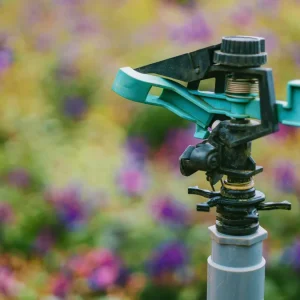
Spray zones win in small, tight spaces because they cover evenly without needing large throw distance. They are the cleanest fit for narrow lawns, short strips, and places where head-to-head coverage is easy to keep consistent.
Picture this: you’re trying to water a side yard that is only a few feet wide. A spray zone can handle that shape without forcing you into oversized heads or awkward overlap.
The strength of spray is coverage pattern. Spray heads make sense when the whole area is close together and the lawn can be hit from a short distance. The weakness is reach. Once the turf area gets bigger, spray can become a dense web of heads that wastes hardware and complicates layout.
A few real drawbacks matter here:
- Spray heads are a poor match for larger turf zones.
- They are not meant for shrub beds or tree rings.
- In irregular spaces, the pattern can leave dry corners or overspray hardscape if the layout is sloppy.
Who Should Skip This: Skip spray zones if your lawn area is broad enough that you start spacing heads just to stretch coverage; rotor zones fit that job better.
Spray is the right call for the person with a compact lawn and a simple layout. If the yard is mostly turf but broken into big open sections, spray stops being the best answer.
Rotor zones: the better fit for bigger lawns
Rotor zones win when turf area is larger and the layout needs reach more than density. They are built for broader lawn sections where a rotating stream can cover more ground with fewer heads.
Picture this: you’re looking at a front yard lawn that runs wider than a narrow strip and would take a lot of spray heads to cover. Rotor is the cleaner fit because it throws farther and handles open turf better.
The appeal is simple: fewer heads can often cover more area, and that makes layout less crowded. Rotor also fits lawns that are a little more forgiving in shape, where the zone can be built around wider spacing instead of tight spray overlap.
But rotor is not the universal answer. The trade-offs are real:
- Rotor is less suited to tiny spaces.
- It is not a good match for planted beds that need low, targeted delivery.
- If the yard has lots of small pockets, rotor can feel oversized and awkward.
Rotor also asks for patience. The water comes in a different pattern than spray, so if the rest of the yard is built around quick surface wetting, rotor can look slow by comparison. That is not a flaw; it is how the zone type works.
The best use case is plain: medium-to-large turf with enough shape to justify the wider throw. If your yard is mostly lawn and you want a zone that can cover it without turning into a head-count problem, rotor is usually the better bet.
Drip zones: the best choice for beds, shrubs, and trees
Drip zones win for planted areas because they put water where roots can use it, instead of spreading it across open ground. That makes drip the most sensible option for shrubs, trees, groundcovers, and mixed beds.
Picture this: you’re standing beside a foundation bed with shrubs in mulch and a few trees nearby. Spray would wet the walkway, rotor would make no sense, and drip can deliver water directly to the planting area.
The advantage is control. Drip is the zone type that fits the plant, not the open space. It helps keep water off pavement, reduces waste in beds, and makes sense where turf-style coverage would be wrong from the start.
Drip’s downsides are just as clear:
- It is not for open lawn.
- It can be more finicky in a bed with changing plant spacing.
- It needs careful layout so emitters land where roots can actually use the water.
That last point matters. A drip zone is not just “less water.” It is a different way of watering. If the bed changes shape often, or the plants get moved around a lot, the zone may need more adjustments than spray or rotor.
Who Should Skip This: Skip drip zones if the area is mostly lawn; rotor zones or spray zones fit turf far better.
Drip is the best answer for planted beds that need targeted watering and for areas where overspray would be a problem.
The honest side-by-side for one yard
Spray, rotor, and drip are not competing for the same job. The better question is which job each area of the yard actually has. That is why mixed irrigation systems often beat a one-zone solution in real properties.
Picture this: you’re trying to map a whole yard with one system. The lawn wants one delivery pattern, the shrubs want another, and the tree line wants something slower again. A single zone type forces at least one part of the yard to take the wrong kind of water.
| Criteria | Spray | Rotor | Winner for [condition] |
|---|---|---|---|
| Turf area size | Best for small turf | Best for medium to large turf | Rotor for broad lawns |
| Bed and shrub use | Poor fit | Poor fit | Drip for planting beds |
| Coverage shape | Tight, compact coverage | Wider reach | Spray for narrow spaces |
| Watering rate | Faster surface wetting | Slower, wider distribution | Spray for short turf runs |
| Overspray risk | Higher if layout is sloppy | Lower on open turf, but still turf-only | Drip near pavement and beds |
| Hardware density | More heads in bigger spaces | Fewer heads in bigger spaces | Rotor for large open lawns |
| Best plant type | Grass | Grass | Drip for shrubs and trees |
| Layout flexibility | Good in small spaces | Good in larger spaces | Mixed zones for one-yard variety |
| Zone conversion ease | Easier to swap in small areas | Easier in turf blocks | Mixed systems when you may revise later |
The result is blunt: if the whole yard is one turf block, rotor often wins; if the area is small and tight, spray wins; if the area is planted, drip wins. If the yard has all three conditions, mixed zones are the cleanest plan.
For readers who want a broader planning framework, the hub on system design and planning explains how these pieces fit into the bigger irrigation layout.
When does a mixed irrigation system make more sense?
A mixed irrigation system makes more sense when one yard has more than one plant type and more than one shape. That is the normal case in many homes, even if the original plan tried to force everything into one zone style.
Picture this: you have a front lawn, a side bed, and a back area with shrubs and a tree. You can make one zone type do some of that work, but it will always be a compromise somewhere.
Mixed systems are strongest when:
- turf and beds are both present,
- the lawn has both wide and narrow sections,
- trees or shrubs need different watering than grass,
- you want zone conversion later without rebuilding the entire yard.
The weakness is complexity. Mixed zones need better planning and more discipline in labeling, controller setup, and maintenance. A homeowner who wants the fewest parts possible may not want that. But the yard may still need it.
A generic article often misses the practical truth: the most efficient system is not always one kind of zone everywhere. In a lot of properties, the smarter design is a combination of spray, rotor, and drip zones that each serve one area well.
Exception scenarios where the rule flips
The general rule is easy: spray for small turf, rotor for larger turf, drip for beds and shrubs. But a few site conditions change the answer fast.
Picture this: you’re looking at a yard that seems straightforward until you notice the slope, the planting density, or the way the lawn breaks around hardscape. That is where the “obvious” choice can turn into a bad one.
-
A very small yard with almost no planting beds.
In that case, one turf zone type may cover almost everything, and the mixed-system advantage shrinks. -
A yard dominated by shrubs and trees, with very little lawn.
Drip can become the main zone type, with only a small spray or rotor section if there is turf at all. -
A property that will be redesigned soon.
A temporary layout may justify the simplest workable zone now, with zone conversion later after the site settles. -
A yard with awkward hardscape lines.
If spray would throw onto pavement or rotor would overshoot a narrow strip, drip or a split layout may be the safer route.
These are not edge cases for the sake of drama. They are the moments when a clean rule needs a second look.
The verdict: which one to choose and why
Choose spray if the space is a small, tight turf area that needs compact coverage. Choose rotor if the space is a larger lawn and you want wider reach with fewer heads. Neither if the area is mainly shrubs, beds, or trees; drip is the better fit there.
That is the clean decision. If one yard contains all three kinds of space, use a mixed system instead of forcing one zone type to do every job.
How should a homeowner make the final call?
Pick the zone type by mapping the yard in this order: plant type, space size, and shape. Plant type comes first because turf and beds do not want the same delivery pattern.
Picture this: you draw the yard on paper and mark grass, shrubs, trees, and hardscape. Once the shapes are clear, the zone choice usually stops being confusing.
Drafted with AI; not yet reviewed by a person.