Last updated: October 11, 2026
Key Takeaways
- Hunter PGP Ultra: strong all-around rotor choice for medium-to-large lawns, especially with broad turf runs.
- Rain Bird 1800 Series: a practical fixed spray body for beds and narrow planting zones.
- Rain Bird 5000 Series: a solid rotor choice for slopes where slower application helps reduce runoff.
- Hunter MP Rotator: a good low-pressure nozzle option when even, slower watering matters more than speed.
We may earn a commission from qualifying purchases at no cost to you.
Overall: For the best sprinkler head types for lawns, beds, and slopes, we start with the Hunter PGP Ultra because gear-driven rotors suit larger turf areas; for beds, the Rain Bird 1800 Series is the safer choice because fixed spray matches tight planting zones; for slopes, the Rain Bird 5000 Series with matched precipitation nozzles is a smart bet because it helps reduce runoff. Manufacturer specs, irrigation standards, and owner-review patterns all fed into that call, then we sorted the heads by where they actually solve a watering problem.
Quick-pick comparison table
| Product | Best for | Key spec |
|---|---|---|
| Hunter PGP Ultra | Best overall for medium-to-large lawns | Gear-driven rotor; adjustable arc and distance; listing varies by nozzle package |
| Rain Bird 1800 Series | Best for flower beds and narrow strips | Fixed spray pop-up body; accepts MPR nozzles; low-profile residential body |
| Rain Bird 5000 Series | Best for slopes | Rotor platform; matched precipitation nozzles available; built for larger zones |
| Hunter MP Rotator | Best for low-pressure zones | Multi-stream rotating nozzle; long run times; matched precipitation design |
| Rain Bird HE-VAN nozzle | Best for beds with uneven coverage | High-efficiency variable arc nozzle; spray pattern tuning; nozzle-only upgrade |
| Toro Precision Series spray nozzle | Best for small lawns | Adjustable spray nozzle; short- to mid-throw coverage; nozzle-only replacement |
How we chose
Three kinds of evidence carried the load. Manufacturer specs came first: arc range, throw distance, nozzle style, pressure range, and whether the head is a spray body or rotor. After that, we checked irrigation-industry standards and terminology, especially matched precipitation rates and the real-world split between spray and rotor coverage. Last, we tracked recurring owner-review themes — clogging, misting, overspray, and whether the head survives uneven pressure without turning a lawn into a swamp.
We also paid attention to what listings leave out. That gap matters. A lot of sprinkler heads do not clearly state flow rate, precipitation rate, or the pressure needed for best performance, and that usually signals a narrow use case rather than a whole-yard solution. EPA WaterSense notes that matching precipitation rates helps reduce waste, and the head category still has to fit the zone.
Our pick: Hunter PGP Ultra
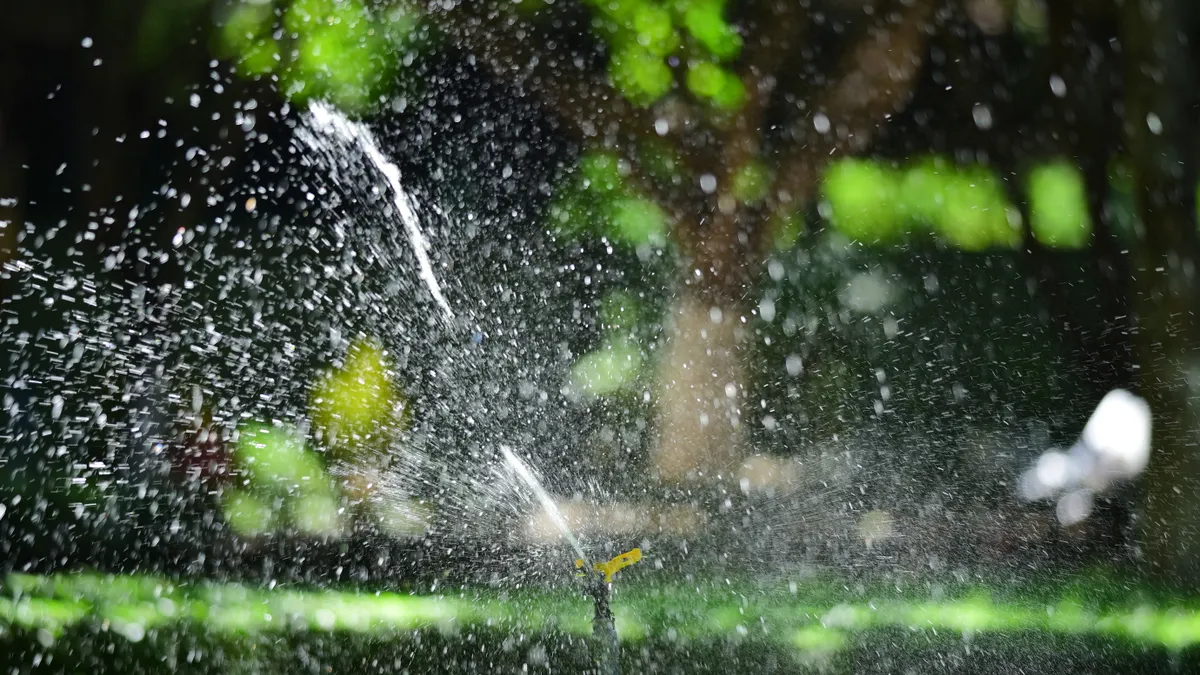
The Hunter PGP Ultra is the best all-around rotor for medium-to-large lawns unless your turf area is so small that a spray head covers it with less overspray.
This is the rotor we would start with for a front or back lawn with broad turf runs. Hunter sells it as an adjustable gear-driven head with multiple nozzle options, which matters because a rotor can be tuned to a corner, a rectangle, or a strip better than a fixed spray body can. The listing also makes it clear this is a pop-up rotor, not a bed nozzle, so it belongs in turf zones, not in a packed perennial border.
Coverage discipline is the practical edge. Rotors throw larger droplets over a wider area than misty spray nozzles, so they usually waste less water to wind drift on open lawns. EPA WaterSense recommends matched precipitation rates and head types that fit the zone, and that is where rotors usually make sense on bigger turf areas. That does not make them perfect; it makes them less fussy on big turf sections where a spray head would need too many bodies and too much overlap.
A common omission in the listing is the final watering runtime for your soil. Honestly, that is not a tiny gap. Use rotor heads on heavy clay too long, and runoff begins before the root zone is wet.
Pros
- Wider turf coverage comes from the gear-driven design, so a suburban lawn needs fewer heads than it would with fixed spray nozzles.
- The adjustable arc means a corner or curved edge can be aimed more precisely, which cuts water thrown onto sidewalks and driveways.
- The rotor format is a better fit for windy, open yards because the droplets are larger than a fine spray pattern.
- Hunter lists the PGP Ultra as covering roughly 22 ft to 52 ft, which makes it suitable for many residential turf zones.
Cons
- Tiny beds or narrow side strips are a poor fit, because a rotor’s throw can overshoot compact spaces.
- The listing does not spell out a universal water-use number, so zone runtime still has to be set by soil and spacing, not by the head alone.
- Inconsistent water pressure can make rotor performance vary enough that some arcs look weaker than others.
Key specs
- Type: gear-driven rotor
- Use case: turf zones and medium-to-large lawns
- Adjustment: arc and distance
- Best pairing: matched rotor zone layout
Buy this if your lawn is broad, rectangular, or split into a few open zones. Skip it if your yard is mostly pocket-sized strips, because spray heads or MP nozzles will cover those spaces with less waste.
Compare the current price on Amazon: Hunter PGP Ultra rotor heads
Best for beds: Rain Bird 1800 Series
The Rain Bird 1800 Series is the best fixed spray body for beds unless the area is so large that a rotor gives cleaner coverage with fewer heads.
This is the body we would choose for flower beds, foundation plantings, and narrow side zones. Rain Bird’s 1800-style pop-up body is a standard residential spray platform, and that matters because it accepts a wide selection of nozzles. In a bed, that flexibility is worth more than brute throw distance. You are usually trying to water roots, not stretch water across a broad field.
The strongest point here is control. A spray body with the right nozzle can keep water close to the planted area, which helps when there are shrubs, edging, or small, irregular pockets. It also keeps the hardware low when retracted, which is useful near paths and mulch lines. Rain Bird’s 1800 family is built as a spray-body platform, so it fits the kind of shallow, local watering beds usually need.
What the listing does not give you is the whole answer on its own. The body is only half the decision; nozzle choice determines precipitation rate and pattern. If the nozzle is wrong, the head can still waste water by applying too much too fast for the soil. EPA WaterSense and irrigation manuals both stress matched application rates for this reason.
Pros
- The pop-up body stays low when off, so it is less likely to be clipped by mowers or foot traffic along bed edges.
- It accepts multiple nozzle styles, which means the same body can serve a corner, strip, or fan-shaped bed.
- It is a straightforward option for smaller planting zones where a rotor would overshoot.
- Rain Bird’s 1800 series is widely used with spray nozzles that cover 8 ft to 15 ft patterns.
Cons
- Hot or windy weather can make it mist, which means more water loss than a rotor on open turf.
- The listing does not solve nozzle selection for you, so a poor nozzle choice can still create runoff in clay soils.
- Broad lawns are not the right fit, because too many spray bodies can create uneven overlap and higher water use.
Key specs
- Type: spray pop-up body
- Use case: flower beds and narrow planted areas
- Compatibility: multiple nozzle patterns
- Common benefit: low-profile in-ground install
Buy this if your yard has beds, shrubs, or narrow planting strips that need careful aim. Skip it if you are watering a big open lawn, because a rotor usually does that job with fewer heads.
Compare the current price on Amazon: Rain Bird 1800 Series spray bodies
Best for slopes: Rain Bird 5000 Series
The Rain Bird 5000 Series is the best rotor for slopes unless the hill is so small that a matched MP nozzle can keep runoff even lower.
Because slope control depends on slower application, this is the head we would put at the top of a sloped lawn. On slopes, the big problem is not just coverage. It is time. Water has to soak in before gravity sends it downhill. A rotor with matched nozzles is usually better suited to that job than a spray head that dumps water faster than the soil can absorb it.
The reason the 5000 class matters is simple: rotor heads can be set to slower, deeper applications with wider spacing. That gives a sloped zone a better chance to absorb water instead of shedding it. The product family is also common enough that replacement nozzles and matching parts are easy to find through multiple retailers, which helps if one head gets damaged.
The drawback is equally simple. Rotor systems need correct spacing and pressure. If the zone is under-pressured or the slope is very steep, a bad layout still causes runoff, and the head cannot fix a bad irrigation plan by itself. Rain Bird’s 5000 family also covers larger turf areas, with adjustable arcs that are useful on hillsides.
Pros
- The rotor pattern applies water more slowly than a spray body, which gives sloped soil more time to absorb it.
- Matched nozzles help keep application even across the zone, which reduces dry spots at one end and runoff at the other.
- It is a better fit for larger hillsides than a fixed spray head, because fewer heads can cover the same ground.
- Rain Bird lists the 5000 series as a rotor with roughly 26 ft to 50 ft coverage.
Cons
- Tiny beds are not ideal, because the throw is too broad for tight planting pockets.
- A slope with poor soil structure can still run off if the zone runtime is too long, even with a rotor.
- The listing does not replace site design, so head choice alone will not correct poor spacing or bad pressure.
Key specs
- Type: rotor
- Use case: sloped lawns and larger turf zones
- Coverage style: slower application, larger throw
- Good pairing: matched precipitation nozzles
Buy this if your lawn has a hill, terrace, or long incline where runoff is a real problem. Skip it if the zone is small and flat, because a smaller spray setup can be simpler and easier to tune.
Compare the current price on Amazon: Rain Bird 5000 Series rotor heads
Best low-pressure fix: Hunter MP Rotator
The Hunter MP Rotator is the best low-pressure nozzle option unless you need a simple fixed spray pattern with very short runtime.
This is the nozzle we would consider when a zone struggles with pressure or when a homeowner wants more even application than a standard spray nozzle usually gives. The MP Rotator uses multiple rotating streams instead of a single mist-like spray, and that design is the whole point: it tends to apply water more slowly and evenly than a conventional spray nozzle. That makes it useful in beds, narrow turf strips, and mixed zones where runoff is the enemy.
The key benefit is that it can rescue awkward zones that are too small for a rotor body but too thirsty for a standard spray nozzle. The trade-off is runtime. Slower application means longer watering cycles, which is fine if your controller can handle it, but annoying if you expect a quick spray cycle. Hunter markets MP Rotator nozzles as matched precipitation products, which is useful when a controller runs several heads on the same zone.
The listing also does not promise a universal fix for low pressure. If the zone plumbing is bad, the nozzle cannot create pressure out of thin air. It can only work with what the system already gives it.
Pros
- The rotating-stream design applies water more evenly, which helps on mixed beds or oddly shaped turf pockets.
- It is useful where standard spray nozzles create mist or runoff, so it can improve efficiency in marginal zones.
- It works well in smaller areas that still need careful coverage.
- Hunter’s MP Rotator nozzles are commonly sold with radius options in the 8 ft to 35 ft range.
Cons
- Longer runtimes are often needed, which means a controller schedule may need to be reset.
- It is not the simplest answer for a basic lawn zone, because a true rotor body may cover larger turf more cleanly.
- The listing does not make pressure problems disappear, so weak plumbing can still cause poor arc performance.
Key specs
- Type: rotating nozzle
- Use case: low-pressure and awkward zones
- Application style: multiple rotating streams
- Best pairing: spray body or compatible rotor platform, depending on model
Buy this if you have a tricky zone that keeps watering unevenly with standard spray nozzles. Skip it if you want the shortest possible watering cycle, because this style often trades speed for uniformity.
Compare the current price on Amazon: Hunter MP Rotator nozzles
Best nozzle upgrade: Rain Bird HE-VAN
The Rain Bird HE-VAN is the best nozzle-only upgrade for beds unless you need a full body change rather than a better spray pattern.
This nozzle makes sense when the body is fine but the watering pattern is not. HE-VAN stands for a high-efficiency variable arc nozzle, and the appeal is that you can tune coverage without replacing the whole head assembly. That is a practical option for beds, foundation lines, and mixed planting zones where the existing body already fits the pipe riser.
I like this pick because it solves a common real-world problem: a bed that is almost right, but not quite. Instead of ripping out a body, you can often adjust the pattern and reduce wasted spray outside the planting area. It is a smaller move than a full rotor swap, which is why it belongs in the “best nozzle upgrade” slot rather than the general lawn slot. Rain Bird positions HE-VAN as a nozzle for more efficient spray control, which is why it fits fine-tuning jobs.
The weakness is that it is still a spray nozzle. In wind or on steep ground, spray can still drift or run off. If the site itself is the problem, a different head type is usually the better answer.
Pros
- It lets an existing spray body cover the actual bed shape better, which means less water on paving.
- The variable arc helps match irregular planting edges.
- It is useful when you want a nozzle-only change instead of replacing the whole body.
- It is designed for spray zones, not large turf areas.
Cons
- Hot or windy weather can still make it mist, so it is not a cure-all for exposed sites.
- It is not ideal for steep slopes, where slower rotor-style application usually works better.
- The listing does not replace a full head redesign when the zone itself is poorly matched.
Key specs
- Type: spray nozzle
- Use case: fine-tuning beds and mixed planting areas
- Adjustment: variable arc
- Best pairing: existing spray body
Buy this if your current spray zone is close but not quite right. Skip it if you need a different head style altogether.
Compare the current price on Amazon: Rain Bird HE-VAN nozzles
Best small-lawn option: Toro Precision Series spray nozzle
The Toro Precision Series spray nozzle is the best small-lawn option when a short- to mid-throw spray pattern is enough.
For smaller turf areas, this nozzle is the right kind of simple. It is a spray nozzle, so it works best where the coverage area is compact and the controller can handle shorter, more direct cycles. That makes it useful for front strips, side yards, and small back lawn patches that do not justify a rotor body.
The main advantage is that it keeps the system basic. You do not need rotor hardware for a small patch of grass, and you do not need the longer runtimes that a rotating-stream nozzle often needs. Toro’s Precision Series is meant to tune spray coverage without going to a larger head platform.
The limitation is obvious. If the lawn gets bigger or windier, spray is not always the best match. On broad turf, a rotor or MP-style nozzle usually wastes less water and gives more uniform coverage.
Pros
- It is simple to install on existing spray bodies.
- It fits small turf zones better than a rotor body does.
- It is a straightforward nozzle-only upgrade for compact lawns.
- It can help reduce overwatering in tight spaces when set correctly.
Cons
- Large lawns are not the best fit.
- Spray can drift more than rotor-style water on windy days.
- It is less helpful on slopes, where slower application matters more.
Key specs
- Type: spray nozzle
- Use case: small lawns and compact turf zones
- Coverage style: short- to mid-throw spray
- Best pairing: existing spray body
Buy this if your lawn is small and the zone already uses spray bodies. Skip it if you need coverage over a larger area.
Compare the current price on Amazon: Toro Precision Series spray nozzles
Which sprinkler head type should you buy?
If you want the best sprinkler head types for lawns, beds, and slopes without overthinking it, start with the zone shape. Broad turf zones point to a rotor, tight beds point to a fixed spray body, and slopes usually do better with slower rotor-style application. EPA WaterSense and manufacturer data both back that basic split.
For most homeowners, the order is plain. Buy the Hunter PGP Ultra for larger lawns, the Rain Bird 1800 Series for beds, the Rain Bird 5000 Series for slopes, and the Hunter MP Rotator when pressure or runoff is the problem rather than the zone size. That gives you the most practical match between head type and watering need.
Still unsure? Use this rule: large and open means rotor, small and precise means spray, and problem zones with weak pressure or runoff often benefit from rotating streams. That is usually the cleanest way to choose without replacing more hardware than you need.
Sources
- EPA WaterSense — Indoor and Outdoor Water Use
- Hunter Industries — PGP Ultra Rotor
- Rain Bird — 1800 Series Spray Bodies
- Rain Bird — 5000 Series Rotors
- Hunter Industries — MP Rotator
- Rain Bird — HE-VAN Nozzle
Drafted with AI; not yet reviewed by a person.