Last updated: October 25, 2026
Quick Answer: Irrigation water source and capacity planning is usually built around peak demand, dependable supply, and a buffer for downtime. The right system still depends on the site, but the first question is whether the source can meet the crop’s worst-case demand in the hottest part of the season.
Irrigation water source and capacity planning is the job of matching a crop’s demand to a reliable supply before a dry week, a hot month, or a pumping restriction exposes a weak system. This guide to irrigation water source and capacity planning asks a practical set of questions: how much water do you need, where will it come from, how fast can you move it, and what happens when the source underperforms?
Key takeaways
- Capacity planning starts with peak demand, not annual demand. A system that looks adequate on paper can fail during the hottest seven to fourteen days of the season.
- Source choice changes more than cost. It affects pumping height, filtration needs, water quality, permitting, drought risk, and how much storage the system needs.
- Surface water often brings volume but also seasonality and debris. Groundwater often brings steadier supply but higher pumping costs or well constraints.
- Storage is not a luxury add-on. In many designs, it is the difference between a workable system and one that collapses when the source is interrupted.
- The right plan includes a margin for downtime, clogged emitters, canal rotation, power loss, and a source that does not perform at its nameplate capacity every day.
What irrigation capacity planning actually has to answer
The capacity question is simple to state and easy to get wrong: can the system deliver the right amount of usable water at the right rate for the worst part of the season?
A serious plan has to answer four numbers, not one. First, the crop’s peak daily or weekly requirement. Second, the source’s dependable yield in the dry period. Third, the distribution system’s flow capacity, expressed as gallons per minute, cubic feet per second, or cubic meters per hour. Fourth, the storage or buffer that bridges the gap between supply timing and crop timing.
That means annual precipitation or average annual diversion volume is not enough. A farm can have enough water across a year and still run short in the week when evapotranspiration spikes and the canal schedule limits delivery to a few hours. The same failure happens with wells that produce well in tests but decline after sustained pumping, or ponds that lose usable volume to sediment, algae, and evaporation.
Irrigation design guidance from the USDA Natural Resources Conservation Service and state extension programs generally treats system sizing as a peak-demand problem; consult a qualified irrigation professional and local extension guidance before final sizing. That order matters because every efficiency assumption can be broken by heat, wind, pressure loss, or maintenance delays. The more variable the source, the larger the buffer you need.
A good plan is usually conservative on purpose. It assumes the source may not always deliver its rated output, the system may not always run continuously, and not every scheduled irrigation window will be available. That approach is wrong for a hobby garden with a hose bib and right for anything that must survive a dry spell without crop stress.
Which irrigation water source fits the job?
The best source depends on reliability, quality, elevation, regulation, and how much treatment or storage you are willing to build around it. Surface water wins when volume is available and timing is manageable. Groundwater wins when consistent delivery matters more than raw volume. Collected rainwater is useful as a buffer, not as the only supply for large acreage.
Surface water: rivers, canals, ponds, and reservoirs
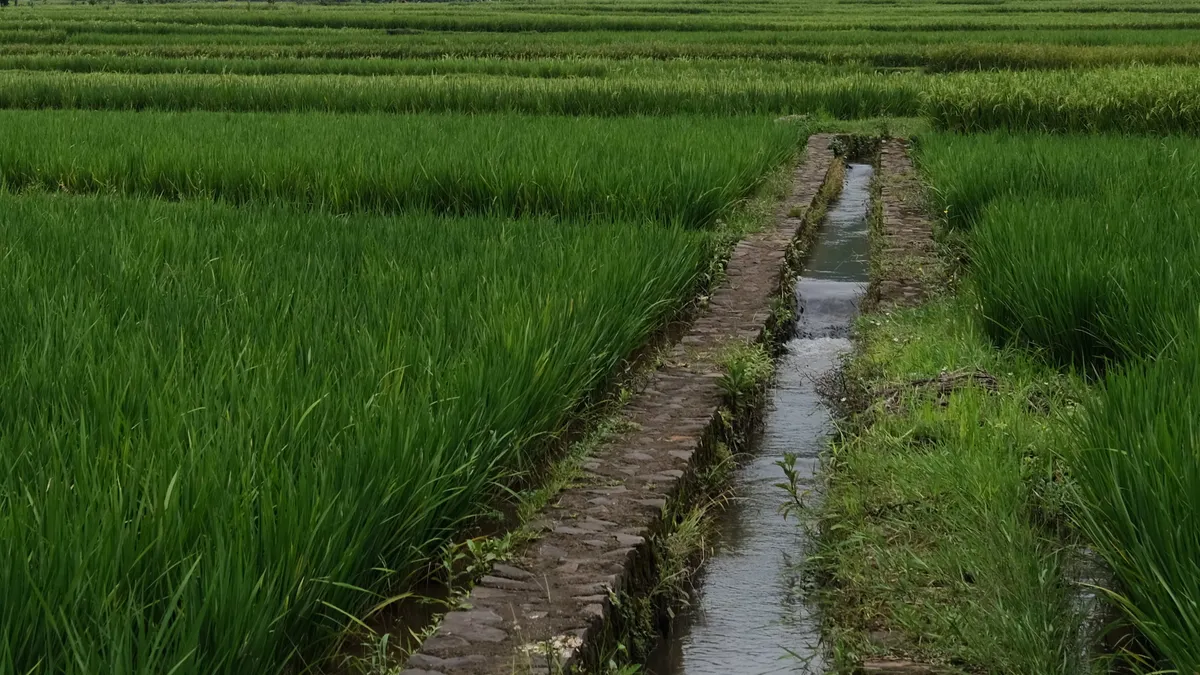
Surface water wins for acreage that needs large volume and can tolerate seasonal delivery. A canal turnout, river diversion, or farm pond can move a lot of water at relatively low source depth, which keeps pumping lift lower than a deep well in some settings. The catch is variability. Sediment, algae, weeds, debris, and changing allocation rules can make the source harder to use than the map suggests.
This option fits growers who can manage intake screening, periodic cleaning, and variable delivery timing. It also fits places where irrigation districts or water-right systems already organize distribution. A canal turn might be available only on certain days or hours; that is not a minor detail. It directly changes the size of the storage pond or balance tank needed to hold enough water between deliveries.
The main weakness is dependence on outside conditions. A reservoir release schedule, upstream demand, drought restrictions, or low river stage can cut capacity without warning. Surface water can also require more filtration, because sediment and organic matter can clog screens and emitters quickly. If the system uses drip irrigation, that is a real cost, not a theoretical one.
Groundwater: wells and aquifers
Groundwater wins when dependable daily supply matters more than source variety. A properly sized well can give a farm a steady flow with less dependence on canal schedules or storm patterns. That steadiness is valuable for orchards, vegetables, nurseries, and any system that cannot tolerate frequent interruptions.
The drawback is that groundwater is rarely “free” just because the water is underground. Pumping depth drives energy cost. Water table decline can force a pump upgrade later. Some wells also produce enough volume for a short test but not enough for the required irrigation run time across a whole season. Well yield, specific capacity, aquifer recharge, and drawdown are the figures that matter, not just the drilling invoice.
Groundwater also creates water-quality questions. High iron, manganese, hardness, salts, or pH imbalance can affect emitters, sprinklers, or crop uptake. In some areas, nitrate levels matter too. If treatment is needed, capacity planning must include not only pump output but also filtration, corrosion control, and maintenance intervals.
This source is wrong for sites where the aquifer is already stressed, where drilling depth is extreme, or where power reliability is poor. A well that needs frequent service or expensive electricity can look solid in the feasibility stage and become the least resilient part of the whole system.
Rainwater and on-site capture
Rainwater capture wins as a supplemental source and fails as a sole source for large irrigation demand in most climates. Roof catchment, lined catch basins, and cisterns are excellent for reducing peak demand on the main source or supporting small high-value areas such as greenhouses, nursery stock, or landscape beds.
The limitation is obvious: collection area is finite, rainfall is seasonal, and storage volume fills and empties quickly. A 10,000-gallon cistern sounds large until the crop needs repeated summer irrigations. Even when the math works on paper, the catchment area may not.
This source is best when the goal is resilience, not total self-sufficiency. It smooths spikes, provides emergency reserve, and reduces pressure on a more expensive source. It is not a substitute for a reliable main supply on broad-acre production unless rainfall and storage are unusually favorable.
How do you calculate how much capacity you need?
You size the system from peak crop demand backward to the source, then add losses and downtime. The cleanest way is to work through irrigation depth, application area, application efficiency, and delivery time.
Start with the crop’s peak water requirement for the hottest part of the season. Extension references often express this as evapotranspiration-based demand, but the exact number depends on crop, growth stage, climate, and soil. Convert that into the depth of water the field actually needs over a chosen period, usually a day or a week.
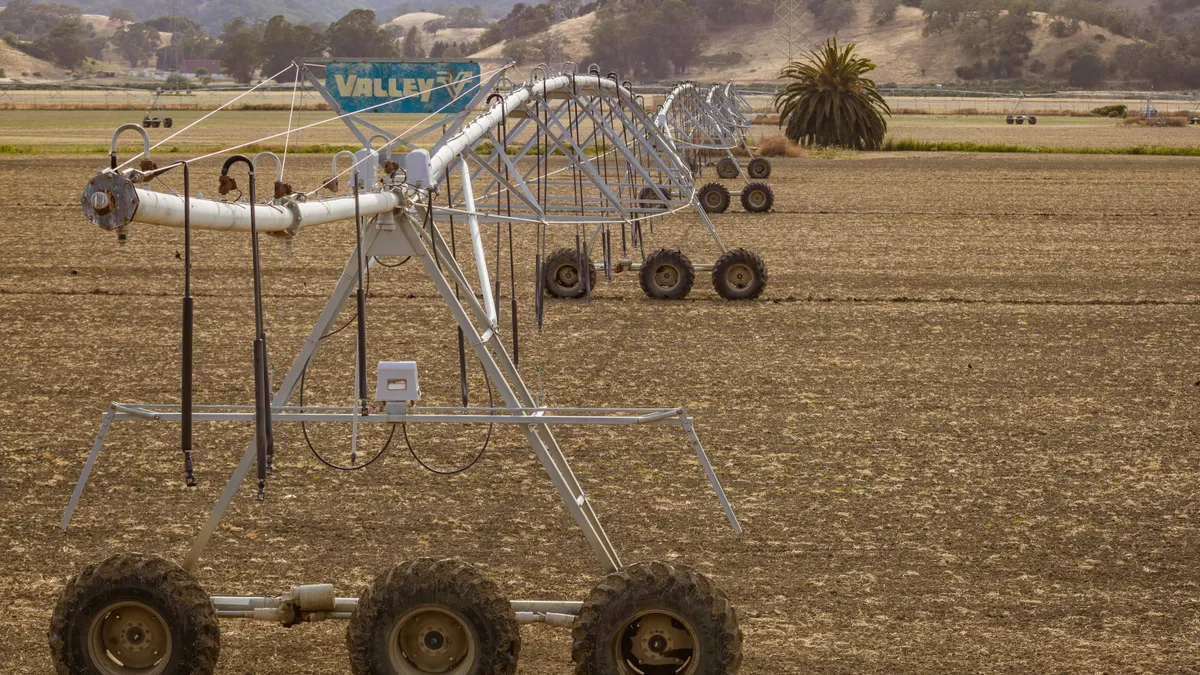
Then adjust for application efficiency. A sprinkler system, center pivot, subsurface drip, and surface irrigation do not deliver the same usable fraction. The less efficient the method, the more source capacity you need. A system that loses more to evaporation, drift, runoff, or deep percolation must move more gross water to achieve the same net crop benefit.
After that, calculate flow rate. A hectare or acre may require a certain depth over a set number of hours. That becomes the pump and pipeline sizing problem. If the field needs irrigation in a 10-hour window but the source can only supply for 6 hours, storage must cover the difference or the schedule must change.
The important part is not the formula alone. It is the margin. A plan that equals peak demand exactly leaves no room for filter backwash, pump maintenance, low-pressure events, or a dry reservoir day. Capacity planning should include a practical reserve, because real systems rarely perform at nameplate rate every hour of the season.
The easiest mistake here is to design for average demand. Average demand is a comfort number, not a design number. If the crop needs 1 inch this week and the system only delivers 0.8 inch because you sized to average conditions, stress appears quickly and yield loss begins before the failure is obvious.
The honest trade-off between source reliability and operating cost
Surface water and groundwater trade places depending on the site, but the pattern is consistent: the more reliable the source, the more it may cost to lift, treat, or permit; the less regulated or cheaper the source, the more often you must solve timing and quality problems.
Surface water usually wins on raw availability where a district or reservoir exists, yet it can force you into storage, intake screening, and delivery windows. Groundwater usually wins on scheduling, yet it can force you into deeper pumping, energy cost, and well rehabilitation.
The same trade-off shows up in treatment. Clearer groundwater may need little more than disinfection or particle filtration. Sediment-laden surface water may need settling, media filtration, screen cleaning, or chemical treatment to protect emitters. A cheap source that destroys filtration hardware or clogs emitters is not cheap after one season.
There is also a regulatory trade-off. Some surface diversions require water-right compliance, diversion measurement, fish screening, or district coordination. Wells may require permits, metering, reporting, setback compliance, or limits on pumping volume. The legal load is part of capacity planning because it can reduce what is usable in practice.
This is why “best source” is the wrong question by itself. The right question is which source best matches the field’s demand profile, the site’s elevation, the expected seasonality, and the owner’s tolerance for maintenance and compliance. A source that looks simple can become the most complicated part of the project.
What storage does that the source itself cannot
Storage turns an intermittent supply into a usable irrigation schedule. That is its main job. It absorbs the mismatch between when water arrives and when the crop needs it.
A pond, tank, reservoir, or lined basin can protect the system from canal rotation, pump maintenance, power interruption, and short-term source decline. It also gives the operator time to manage filtration and sedimentation before the water reaches the field. In many designs, storage is not backup capacity; it is operational capacity.
The right storage size depends on three things: source reliability, crop sensitivity, and delivery timing. A high-value crop with shallow roots needs a smaller interruption window than a forage field. A canal-fed operation with weekly delivery may need much more storage than a well-fed one. A site with high evaporation and seepage losses needs a larger net volume than the raw demand alone suggests.
Storage has real downsides. It costs money, occupies land, and can lose volume to evaporation, seepage, algae growth, or sedimentation. Open water can also create safety and permitting issues. A storage pond is not a free backup tank; it is another asset that must be built, lined, managed, and sometimes protected from contaminants.
The strongest case for storage is a source that is dependable in total volume but unreliable in timing. The weakest case is a site that already has a steady well and little interruption risk. In that case, a big pond may be extra capital without enough operational value.
How source quality changes the whole design
Water quality changes pump selection, filtration, emitter choice, maintenance frequency, and sometimes crop choice itself. Planning only for volume and ignoring quality is one of the fastest ways to build a system that works for one season and degrades after that.
Sediment load is the obvious issue. Sand, silt, and organic matter can wear pumps, clog screens, and foul drip lines. Iron, algae, and dissolved minerals can also cause recurring fouling that builds up over time instead of causing one blockage. Salinity is a crop issue as much as a plumbing issue, especially in sensitive vegetables, orchards, and greenhouse systems.
That means the source decision and the distribution decision cannot be separated. A low-quality source may still be useful if the crop can tolerate it and the treatment train is designed correctly. A clean source may still fail if it requires pumping from too deep, arrives at the wrong time, or cannot be stored.
Filtration is not optional when the source carries debris or suspended solids. The exact equipment depends on the particle load and emitter sensitivity, but the planning rule is constant: if the source is dirtier, the system needs more treatment margin and more maintenance time. Ignore that, and capacity shrinks over the season even if the pump size never changes.
For planning purposes, source quality is a capacity issue. It affects how many gallons or cubic feet per hour are truly usable, not just how much sits in the aquifer, canal, or pond.
The head-to-head comparison that changes the decision
Surface water wins when volume and low lift matter most. Groundwater wins when schedule control and steady delivery matter most. The better choice depends on which constraint will break the farm first.
| Criteria | Surface Water | Groundwater | Winner for [condition] |
|---|---|---|---|
| Seasonal reliability | Can swing with rainfall, reservoir release, and allocation rules | Often steadier day to day, though drawdown can reduce yield | Groundwater for predictable weekly scheduling |
| Peak volume availability | Often high if the source and rights exist | Limited by well yield and aquifer response | Surface water for large peak irrigation events |
| Pumping energy | Can be moderate if source is near field elevation | Can rise sharply with well depth and drawdown | Surface water when lift is low |
| Filtration burden | Usually higher because of sediment and debris | Often lower, unless iron, manganese, or hardness are high | Groundwater for drip systems |
| Storage requirement | Often higher because delivery timing may be fixed | Often lower if pumping can match demand | Groundwater when pumping windows are flexible |
| Permitting and compliance | Can involve diversion rules and water-right limits | Can involve well permits, metering, and pumping limits | Depends on local regulation |
| Water quality variability | Usually higher | Usually lower, but not always cleaner | Groundwater when crop sensitivity is high |
| Capital cost pattern | Intake, screening, conveyance, possibly storage | Drilling, pump, power, possible treatment | Surface water if existing infrastructure is nearby |
| Risk of sudden outage | High if flow depends on district timing or river stage | Moderate, but pump or power failure can stop supply | Groundwater for operational control |
| Best fit | Larger acreage with managed timing | High-value crops needing dependable scheduling | Depends on the bottleneck |
This comparison does not say one source is always better. It says each source wins when the field’s failure mode matches its strengths. If the crop dies from timing gaps, groundwater usually wins. If the crop dies from insufficient total volume, surface water usually wins. If the site has both problems, the answer is usually a hybrid system with storage.
When to choose one source, and when to combine them
Choose surface water if the site has access to a dependable canal, river diversion, or pond and the main problem is moving enough volume at low lift. It is the right call when the area is large, the source is seasonal but adequate, and the system can tolerate storage and filtration. It is also the better choice when groundwater is too deep, too expensive to pump, or too constrained by aquifer condition.
Choose groundwater if the crop needs tight scheduling, the acreage is moderate, and pumping cost is acceptable. It is the cleaner choice for orchards, vegetables, greenhouses, and other high-value plantings that suffer more from timing misses than from total annual scarcity. It also fits sites where water-right complexity or surface delivery timing would make operations brittle.
Choose both when the risk of single-source failure is too high. A well plus pond, a canal plus tank, or a captured-rain supplement plus primary source can create resilience that one source alone cannot. The hybrid system is especially strong when one source is cheap but erratic and the other is expensive but controllable. That combination gives the operator a daily supply and a reserve for peak periods.
The hybrid option is wrong for small budgets that cannot maintain two systems well. Two weak systems are not better than one well-managed one. A partly finished pond and an undersized well can consume capital without solving the seasonal bottleneck.
What most planning articles leave out
Most generic guides stop at “calculate demand and size the pump.” That is not enough. The hard part is not the arithmetic; it is the mismatch between source timing, water quality, legal constraints, and the crop’s tolerance for interruption.
The first missing piece is duty cycle. A pump can be rated for a flow number, but the real question is whether it can sustain that output across the actual irrigation window without overheating, cavitating, or dropping pressure. The second missing piece is delivery timing. A source that yields 100 gallons per minute for two hours is not equivalent to one that yields 50 gallons per minute for four hours if the crop needs continuous coverage.
The third missing piece is failure planning. What happens if the canal runs short for three days, the well motor fails, or the intake screen clogs? A serious design includes a backup mode, not just a normal mode. The fourth missing piece is operating labor. A system that needs frequent cleaning or manual valve changes may be technically adequate and practically poor.
The best capacity plan treats the source as a living constraint, not a static spec. That is why the recommendation changes by crop, climate, and delivery schedule. The right answer in a desert orchard is not the right answer in a humid vegetable block or a pasture rotation.
What should you do if the site is on the edge of two options?
If the site sits between two workable choices, choose the one that gives the crop the least risk during the hottest part of the season.
If both sources can cover average demand, pick the one that can still deliver during a 7- to 14-day peak stress period without special favor. If both can technically work but one depends on perfect timing, the other usually wins. If one source is cheaper but needs more treatment, and the crop is high value, the more controllable source usually wins.
Choose surface water if the site has a strong allocation, low lift, and a realistic storage plan. Choose groundwater if the system must run on schedule and the well yield is stable enough across the season. Choose neither if the field is too large for the dependable supply, the quality problem is severe, or the regulatory load makes the project fragile from the start.
A capacity plan that assumes ideal weather, perfect equipment, and uninterrupted delivery is not a plan. It is a hope with a pump attached.
What do the best source plans have in common?
They all start with the crop’s peak demand, not with the cheapest source on the map. They all include a buffer for downtime, quality loss, and schedule mismatch. They all treat storage as part of capacity, not as an afterthought. They all check pumping lift, filtration needs, and legal limits before the design is locked in.
A good irrigation water source plan is conservative, specific, and realistic. It does not promise that a single source will do everything. It identifies where the system is vulnerable and adds enough margin to survive the worst week of the season.
Choose groundwater if the crop needs precise timing and the well can sustain the required flow across the season. Choose surface water if the site needs large volume and the delivery system can support storage and filtration. Neither works well if the source cannot reliably cover peak demand, because the crop will not wait for a better year.
Drafted with AI; not yet reviewed by a person.